Part of our Joint Genesis overview. Label and studies checked October 19, 2026.
We earn a commission if you buy through our links. These views are our own, not BIODYNAMIX's. Last updated October 19, 2026; check the vendor checkout via our link for current prices.
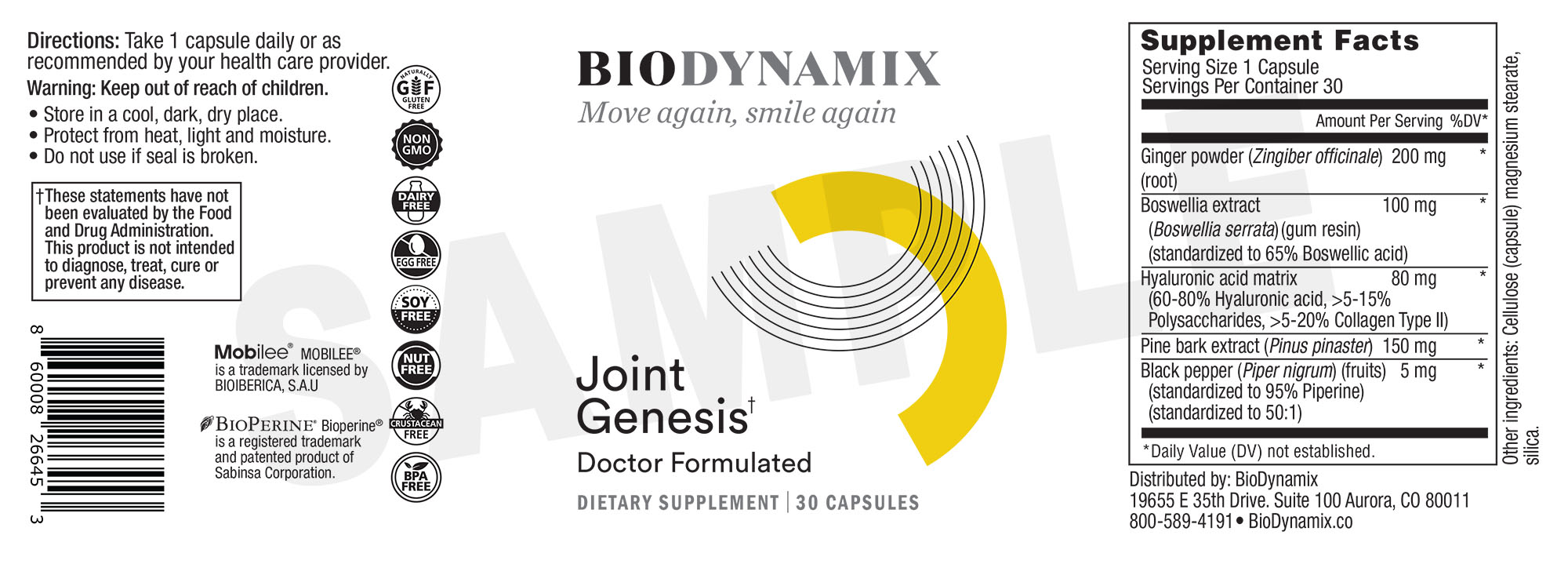
The Joint Genesis ingredients list is short and fully disclosed. Each capsule holds five actives with a printed dose and no proprietary blend, so every line can be checked against published research.[2]
What are the Joint Genesis ingredients?
One capsule contains 535 mg of actives: ginger, pine bark, boswellia, a hyaluronic acid matrix and black pepper extract. A bottle holds 30 capsules, one a day.[2]
| Ingredient as printed | Per capsule |
|---|---|
| Ginger powder (Zingiber officinale) (root) | 200 mg |
| Pine bark extract (Pinus pinaster) | 150 mg |
| Boswellia extract (Boswellia serrata) (gum resin), standardized to 65% boswellic acid | 100 mg |
| Hyaluronic acid matrix (60 to 80% hyaluronic acid, over 5 to 15% polysaccharides, over 5 to 20% collagen type II) | 80 mg |
| Black pepper (Piper nigrum) (fruits), standardized to 95% piperine | 5 mg |
| Other ingredients | Cellulose (capsule), magnesium stearate, silica |
The side of the label says MOBILEE is a trademark licensed by Bioiberica and that BioPerine belongs to Sabinsa, though neither name sits beside its ingredient line.[2]
How do the Joint Genesis doses compare with study doses?
Two of the five match. The hyaluronic acid and pine bark doses equal amounts used in trials, while ginger and boswellia fall short of most joint studies.
| Ingredient | Joint Genesis | Amount in joint studies | Evidence grade |
|---|---|---|---|
| Hyaluronic acid matrix | 80 mg | 80 mg (Mobilee) to 200 mg[3][4] | Limited |
| Pine bark extract | 150 mg | 100 to 150 mg[6] | Limited |
| Boswellia extract | 100 mg, 65% boswellic acid | 100 to 250 mg of AKBA-enriched extract[10][18] | Moderate for the studied extracts |
| Ginger | 200 mg root powder | Concentrated extracts, usually twice a day[12] | Limited |
| Black pepper extract | 5 mg | 20 mg in absorption studies[15] | Absorption aid only |
Grades rate the research on each ingredient, not Joint Genesis, because no trial of the capsule exists. Our method is on the how we review supplements page.
What does the hyaluronic acid in Joint Genesis do?
Oral hyaluronic acid has small, short trials with modest results for knee comfort. The 80 mg matrix matches the Mobilee dose its maker tested.
In an 80-person, 12-week study, a yoghurt with 80 mg of Mobilee raised knee muscle strength by at least 11% in men, with no change in women; pain was not the main outcome.[4] A 60-person trial of 200 mg a day for 12 months beat placebo only in people aged 70 or under.[3] A review by authors linked to the maker called the 2008 to 2015 trials positive.[5]
The sales page says Mobilee can "multiply hyaluronan molecules in the synovial fluid by a factor of 10".[1] That figure comes from the vendor, and no trial we read measured it in people. Mobilee is made from rooster comb, a point the label leaves out.
Does the pine bark extract in Joint Genesis help knees?
One decent trial says it may. A 100-person study of 150 mg a day for 3 months found lower knee pain and less painkiller use.[6]
That trial used Pycnogenol. The Joint Genesis label says only "Pine bark extract (Pinus pinaster)" with no brand, so we cannot confirm it is the same material.[2] A Cochrane review of 15 trials found the evidence "insufficient to support Pycnogenol use for the treatment of any chronic disorder".[7] LiverTox lists pine bark as generally recognized as safe.[8]
Is the boswellia in Joint Genesis strong enough?
The dose sits at the low end of the trial range. Positive trials mostly used extracts enriched in AKBA, and the label gives only "65% boswellic acid".
A 2020 meta-analysis of 7 trials and 545 people found lower knee pain and stiffness with boswellia.[9] A 60-person trial found benefits at 100 mg of two branded AKBA extracts.[10] Most of these trials were run by the extract makers. NCCIH calls boswellia "likely to be safe when taken orally".[11]
How much ginger is in Joint Genesis, and is it enough?
It has 200 mg of plain root powder, the largest dose on the label. The joint trials used concentrated ginger extracts, so this amount is lighter than what was studied.
A 2015 meta-analysis of 5 trials and 593 people called ginger "modestly efficacious" for osteoarthritis pain, and people taking it were more than twice as likely to drop out.[12] A 2020 meta-analysis rated the evidence poor and said it was insufficient to back ginger over placebo for knee osteoarthritis.[13] Heartburn and stomach upset are the usual complaints.[14]
Why does Joint Genesis contain black pepper extract?
Piperine is there to help absorption, not to act on joints. Its best-known human data show it raising curcumin levels, and Joint Genesis contains no curcumin.
In the classic study, 20 mg of piperine with 2 g of curcumin raised curcumin absorption 2000%.[15] Joint Genesis has 5 mg. Piperine also slows how the body clears some medicines; in one study it raised carbamazepine levels by 68.7%.[16]
Are the Joint Genesis ingredients safe?
The doses are modest, but three ingredients need care if you take prescription drugs. Ginger, pine bark and piperine can matter with blood thinners, and piperine can change levels of other medicines.
Ginger appears on a review's list of herbs linked to raised bleeding risk with warfarin.[17] Ask a doctor first if you take anticoagulants, antiepileptics or other daily medicines, have surgery coming up, are pregnant, or avoid animal products. Our Joint Genesis side effects page covers reported reactions in more detail.
Which joint ingredients are not in Joint Genesis?
There is no glucosamine, chondroitin, turmeric, MSM or omega-3 on the label.[2] Research on those says nothing about this capsule. For context, see our guide to glucosamine and chondroitin for knee pain.
Ingredient studies cannot show what this five-part mix does in one capsule. We weigh that in does Joint Genesis work, and how to take Joint Genesis covers timing.
What is our take on the Joint Genesis formula?
The label is honest and easy to check. The evidence behind it is modest. Hyaluronic acid and pine bark land on trial doses, boswellia and ginger come in light, and piperine has nothing to boost except the other four.
Price, refunds and the full verdict are in our Joint Genesis overview.
Frequently asked questions
What are the main ingredients in Joint Genesis?
Each capsule has ginger root powder 200 mg, pine bark extract 150 mg, boswellia extract 100 mg, a hyaluronic acid matrix 80 mg and black pepper extract 5 mg. The other ingredients are a cellulose capsule, magnesium stearate and silica.
Does Joint Genesis contain glucosamine or turmeric?
No. Glucosamine, chondroitin, turmeric, MSM and omega-3 are not on the label. Studies of those ingredients cannot be used to judge Joint Genesis. Its hyaluronic acid matrix and pine bark extract are the two lines with dose-matched knee trials.
Is the hyaluronic acid in Joint Genesis Mobilee?
The label side text says MOBILEE is a trademark licensed by Bioiberica, and the 80 mg dose matches Mobilee trials. The ingredient line itself does not name it, and the label does not say the matrix comes from rooster comb.
Is Joint Genesis a proprietary blend?
No. All five active ingredients carry an exact dose on the Supplement Facts panel, totaling 535 mg per capsule. That makes the formula easy to compare with published studies, which is the main strength of the label.
Who should check with a doctor before taking these ingredients?
Anyone on blood thinners, antiepileptics or other daily medicines, since ginger, pine bark and piperine can matter with them. Also people with surgery planned, pregnant women and those who avoid animal-derived ingredients, because the hyaluronic acid source is not stated.
Sources
- Joint Genesis sales page and FAQ. BIODYNAMIX, completejointcare.net, undated (read October 19, 2026).
- Joint Genesis Supplement Facts label. BIODYNAMIX, undated (read October 19, 2026).
- Tashiro: oral hyaluronan in knee osteoarthritis, 60 people. PubMed, 2012 (read October 19, 2026).
- Rooster comb extract yoghurt and knee muscle strength, 80 people. PubMed abstract (read October 19, 2026).
- Review of oral hyaluronic acid trials. PubMed abstract (read October 19, 2026).
- Farid: pine bark extract in knee osteoarthritis, 100 people. PubMed, 2008 (read October 19, 2026).
- Cochrane: Pycnogenol for chronic disorders. PubMed, 2012 (read October 19, 2026).
- Pine Bark. LiverTox, NIH (read October 19, 2026).
- Boswellia for osteoarthritis, meta-analysis of 7 trials. PubMed, 2020 (read October 19, 2026).
- Sengupta: two AKBA boswellia extracts vs placebo, 60 people. PubMed, 2010 (read October 19, 2026).
- Boswellia. NCCIH, archived copy (read October 19, 2026).
- Bartels: ginger for osteoarthritis, meta-analysis of 5 trials. PubMed, 2015 (read October 19, 2026).
- Oral ginger for knee osteoarthritis, meta-analysis. PubMed, 2020 (read October 19, 2026).
- Ginger. NCCIH, archived copy (read October 19, 2026).
- Shoba: piperine and curcumin absorption. PubMed, 1998 (read October 19, 2026).
- Piperine and carbamazepine levels. PubMed abstract (read October 19, 2026).
- Herbs and bleeding risk with warfarin, systematic review. PubMed abstract (read October 19, 2026).
- Sengupta: 5-Loxin 100 or 250 mg in knee osteoarthritis, 75 people. PubMed, 2008 (read October 19, 2026).
This page is general information, not medical advice. Dietary supplements are not reviewed by the FDA for safety or effectiveness before they are sold and are not intended to diagnose, treat, cure or prevent any disease. Talk to your doctor before taking any supplement, especially if you are pregnant, nursing, take medication or have a health condition.